Field Note
Right to repair: Restoring the Sony a6000 with Open-Source Tools
Published: 2026-07-15 · Reading Time: 3 min
Sony tried to remotely lobotomize my a6000, and I took that personally.
I didn’t wake up planning to have a battle with a multi-billion-dollar tech conglomerate - I just wanted to shoot a damn double exposure in-camera. Instead, I found myself staring at the LCD screen of my Sony a6000, reading a corporate death sentence:
"The application download service has ended."
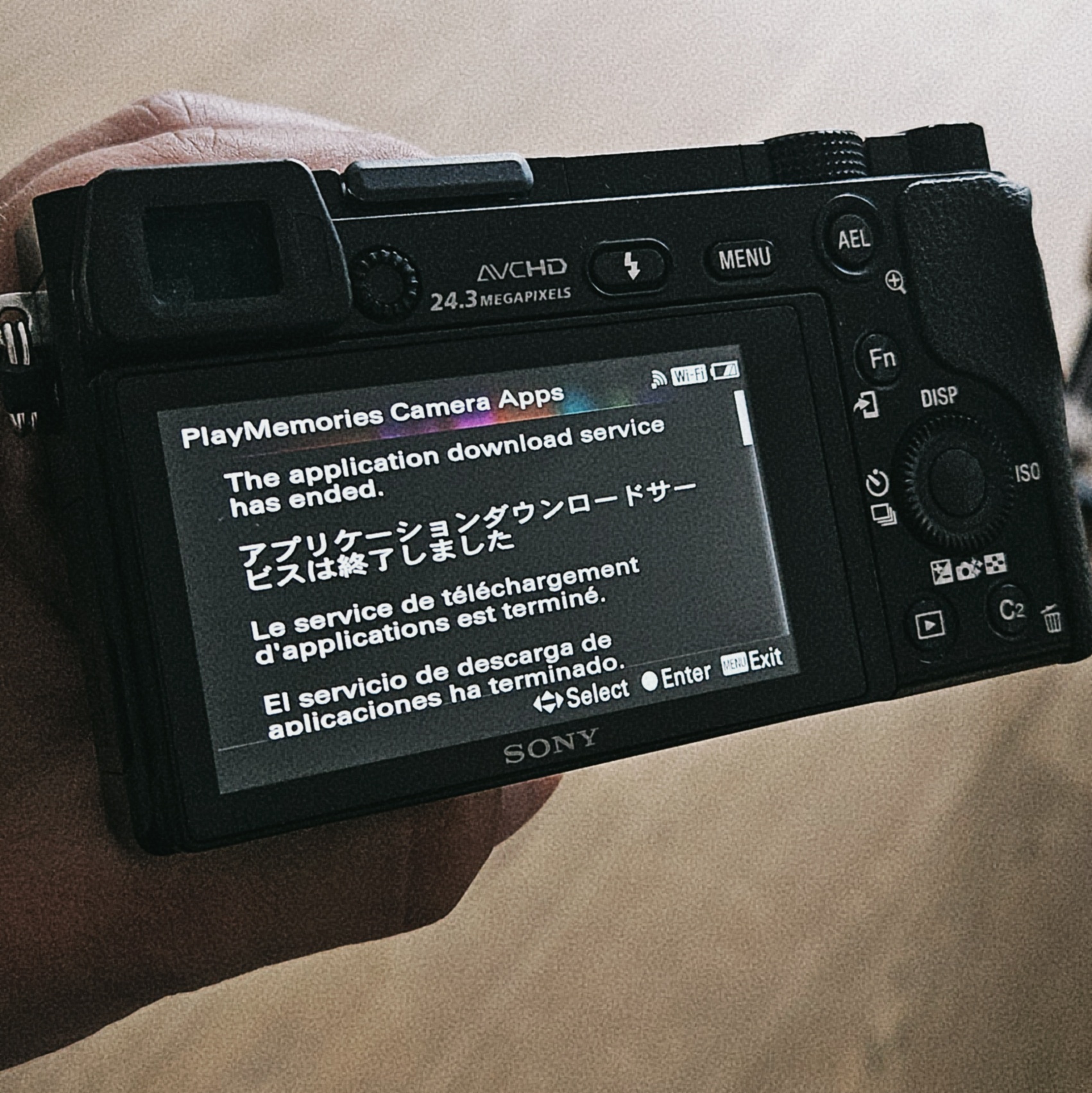
That little error message is the modern corporate middle finger. I paid cold, hard cash for this camera and the features printed right there on the original box. But because some bozo in a boardroom decided the PlayMemories server was too expensive to keep on life support, so my hardware got remotely kneecapped.
Welcome to Techno-Feudalism, you will own nothing
This is the exact dystopian nightmare Right to Repair advocate Louis Rossmann has been screaming about for years. You don't actually own your stuff anymore; you're just leasing the privilege of holding it until the manufacturer gets bored and flips a kill switch.
Rossmann has built an entire movement fighting this specific breed of techno-feudalism, putting his money where his mouth is by funding reverse-engineering projects through the FULU bounty network and exposing corporate sabotage on the Consumer Rights Wiki. It’s the terrifying reality that major corporations can reach into your bag from across the globe and lobotomize your property. It’s theft, plain and simple, dressed up as an "end-of-life" service bulletin.

The Open-Source Resistance
I tend to not take things personally, except when I do. That error screen kicked off a frantic deep-dive into the wild, brilliant world of the open-source community. I figured if Sony wouldn’t let me use the camera I bought, the internet would.
Enter `ma1co`. I stumbled onto their GitHub repository called `Sony-PMCA-RE`. They reverse-engineered Sony’s locked-down firmware, completely bypassed the dead servers, and made it so accessible and easy-to-use that even I could do it.
But as the repo itself notes, it stands on the shoulders of giants: the pioneering reverse-engineering work done by the early development community at nex-hack. Years before Sony pulled the plug on the app store, those developers were doing God's work by laying the structural groundwork that made modern homebrew camera tweaks possible.
> Is it safe? I don't know, probably. If you break your camera, you get to keep the pieces. We are firmly in 'godspeed and good luck' territory here.

Taking Back True Hardware Ownership
With a standard USB cable, a Linux terminal, and a few keystrokes, I hijacked my own camera back from the corporate graveyard. Not only did I recover my missing double exposure and time-lapse functions, I also sideloaded archived Sony PlayMemories apps hosted on the Internet Archive that were supposed to be dead forever. My old a6000 is now infinitely more powerful than the day I unboxed it.
And this isn't just an isolated nerdy battle anymore; the law is finally trying to catch up to the code. We are living through a massive historical shift for consumer autonomy. The European Union's landmark Directive on common rules promoting the repair of goods that was originally adopted in June 2024, is now reaching its final, critical enforcement deadline. Member States are in the final weeks of locking these rules into national law before the July 31, 2026 enforcement deadline, legally forcing manufacturers to halt software and hardware blocks that stop independent repairs or kill device lifespans.
(I'll update this after the deadline and see who actually got something done)
> The Directive aims at encouraging consumers to use their goods for longer thus preventing premature disposal of repairable goods. It establishes a number of measures to promote repair...
The era of being a passive, obedient consumer has to end. When corporations try to brick the gear you paid for, you don't reward them by buying the new model.
You find (or create) the community, you run the code, and you take your property back.